
Get Started

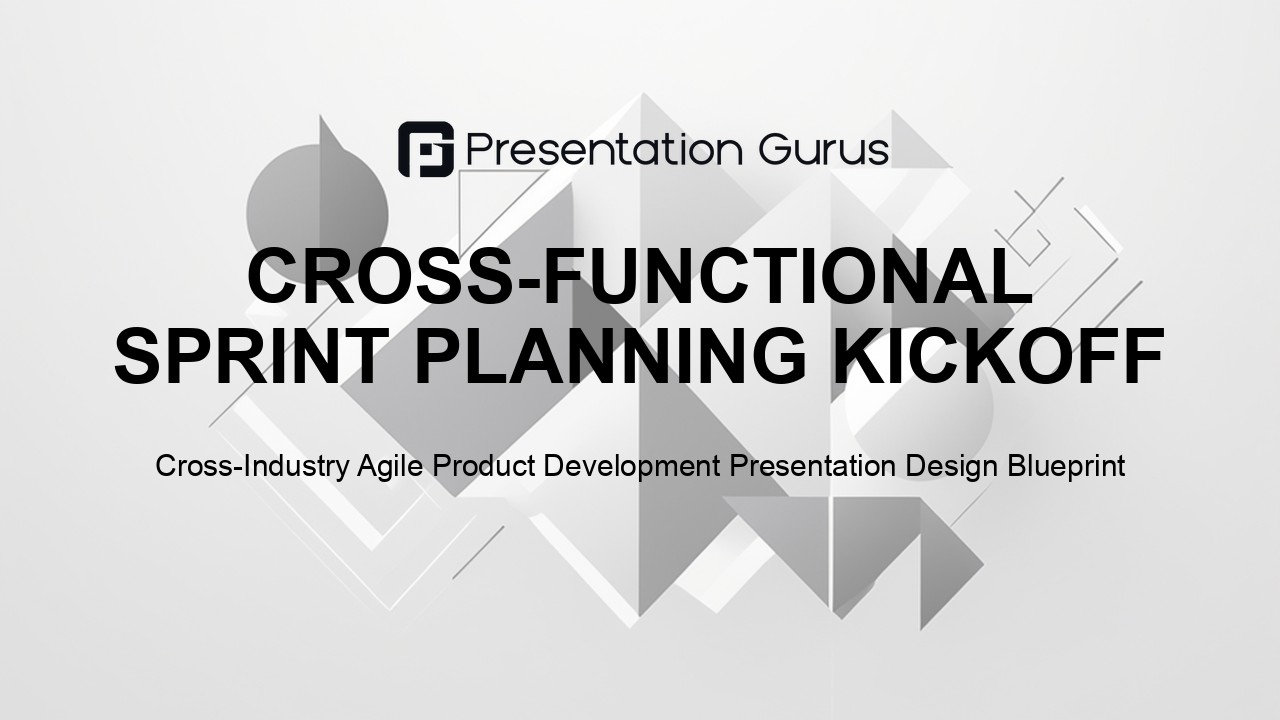
Cross-Functional Sprint Planning Kickoff

White Paper
Cover

A sprint planning kickoff is a deceptively high-stakes 2-hour window. Teams arrive exhausted from async standups, backlog grooming sessions sprawled across email and chat, and competing interpretations of what 'ready' actually means. The executive producer of this deck is usually a product leader or scrum master holding no formal authority over engineers or design leads—only the power of clear narrative and shared visual language. The blueprint presented here demonstrates how to structure that presentation using a strategic framework that mirrors how teams actually make commitments: by seeing capacity, understanding priority, recognizing risk, and then choosing to execute. It is not a template for a Gantt chart or a backlog dump. It is a communication architecture designed to move a distributed team from fragmented understanding to unified action within a two-hour block, and to hold that alignment across the full sprint cycle.

The following is an anonymized portion of a slide deck developed for a Cross-Functional Sprint Planning Kickoff. We are providing only ten slides, which will give you a clear and detailed explanation of thought process, strategy, and use of various presentation skills and tools, including copywriting, neurolinguistic programming, and persuasion mastery.

This is also a presentation in wireframe format only. This is nowhere even close to a design — it is solely created for story flow and strategy.

NARRATIVE FLOW & SLIDE ARCHITECTURE

1

Sprint Charter & Strategic Objectives

Every sprint exists in service of a specific business outcome, not just task completion. Teams commit harder when they know *why* the work matters.

  • Anchors the 2-hour session in a single shared mission, reducing cognitive fragmentation.
  • Signals that this meeting is not a task dump—it's a collaborative commitment to a specific outcome.
  • Establishes the decision frame: all 10 slides will build toward this mission.
Sprint Charter & Strategic Objectives

Two-week execution block | Product, Engineering, Design aligned

2

Backlog Landscape & Prioritization Logic

Transparent prioritization removes the politics from sprint planning. Teams see why certain work is chosen and trust that the backlog has been deliberately groomed.

  • Demonstrates leadership has done the analytical work upstream, not dragging teams into a backlog review.
  • Creates visual proof that competing demands (feature work, technical debt, risk mitigation) are all considered and balanced.
  • Allows teams to spot missing dependencies or unclear estimates before committing.
Backlog Landscape & Prioritization Logic

Clear prioritization logic, not random selection

3

Team Capacity & Resource Allocation

Teams lose trust in sprint planning when they see unrealistic velocity targets from the start. Honesty about capacity—and visibility into how it was calculated—builds credibility and enables real commitment.

  • Quantifies the actual working hours and resources; removes guesswork from 'will we finish?'
  • Shows buffer built in for critical production issues, so teams know unexpected work won't automatically derail the sprint.
  • Allows teams to voice unplanned PTO or constraints that weren't visible upstream.
Team Capacity & Resource Allocation

Realistic utilization with a 6% buffer for interrupts

4

Prioritized Work Items & Team Assignments

Ambiguous ownership is the root of sprint failure. When every task has a named owner and a realistic point estimate, teams move faster and accountability becomes frictionless.

  • Eliminates the post-kickoff email chain asking 'who's taking this?' by assigning before the meeting ends.
  • Gives each person a concrete, visible workload so they can negotiate scope or ask for help *before* the sprint starts.
  • Creates a reference artifact that teams can reference in daily standups—reducing re-planning overhead.
Prioritized Work Items & Team Assignments

Clear ownership removes decision-making overhead during execution

5

Technical Risk Assessment

Technical risks that surface mid-sprint kill velocity. Surfacing them before kickoff allows teams to plan workarounds, allocate contingency resources, or descope non-critical work upfront.

  • Demonstrates leadership understands the technical complexity and isn't naive about obstacles.
  • Gives engineering and design leads permission to voice concerns before commitment—preventing the 'we knew this would break' conversation post-sprint.
  • Creates a mitigation plan for each risk (e.g., 'Database team will run schema migration dry-run on day 1') so risk is managed, not just acknowledged.
Technical Risk Assessment

Database migration, third-party API rate limits, design QA bottleneck

6

Cross-Team Dependency Map & Critical Path

Dependencies that aren't visualized become surprises that derail sprints. A clear critical path shows teams exactly which work needs to complete first, so parallel work can proceed without risk of blockage.

  • Prevents the 'waiting for Backend' conversation mid-sprint by showing Frontend exactly when to start their integration work.
  • Identifies which teams need to collaborate most tightly and allocates communication overhead upfront.
  • Buffer built into critical path signals that leadership understands Murphy's Law—things slip, and the schedule accounts for it.
Cross-Team Dependency Map & Critical Path

Prevents mid-sprint bottlenecks through upfront sequencing

7

Success Metrics & Velocity Targets

Velocity targets mean nothing unless teams understand what 'done' actually means. Defining success as 'shipped feature count AND quality threshold' aligns engineering and product on trade-offs upfront.

  • Connects abstract story points to concrete business outcomes (features shipped, quality standard maintained).
  • Shows the stretch goal (76 vs. historical 72) is ambitious but grounded in data, not wishful thinking.
  • Distinguishes between velocity and quality: teams can't optimize for one without understanding the other.
Success Metrics & Velocity Targets

Ambitious but realistic; two definitions of 'done'

8

Communication Protocol & Daily Cadence

Scattered communication—Slack, email, ad-hoc calls—kills sprint focus. A predictable cadence with clear purposes lets teams block out deep work and reduces the cognitive overhead of 'staying aligned.'

  • Reduces Slack noise by channeling status updates into structured standups, not random messages.
  • Gives teams permission to work heads-down between touchpoints, knowing blockers will be aired at specific times.
  • Clarifies which conversations belong in standup (blockers), which in cross-team sync (dependencies), and which in retro (process improvement).
Communication Protocol & Daily Cadence

Clear synchronization prevents status-update thrashing

9

Escalation Framework & Decision Rights

Undefined decision authority creates paralysis. Engineers wait for permission on decisions they could make, PMs get pulled into micro-issues that shouldn't reach them. Clear escalation rules let each level focus on their own scope.

  • Distributes decision-making authority so blockers resolve at the lowest capable level.
  • Prevents leadership from being overwhelmed with non-critical escalations by setting explicit thresholds.
  • Gives junior engineers and PMs a framework for knowing when to escalate vs. when to decide locally.
Escalation Framework & Decision Rights

Empowered execution, escalation only when necessary

10

Sprint Commitment & Execution Launch

Commitment is not dictated; it is chosen. By walking teams through the logic and data, this final slide invites them to choose to commit, rather than forcing compliance. That choice drives accountability.

  • Summarizes the entire narrative arc: mission, backlog, capacity, risks, dependencies, metrics, cadence, authority—all visible before the final commitment.
  • Signals that kickoff is over and execution begins; teams now own the plan and should execute with autonomy.
  • Creates a psychological moment of commitment: teams have a chance to voice last concerns before 'go' is called, so silence is assent.
Sprint Commitment & Execution Launch

Teams own this plan. Let's execute.

Presentation Architecture & Persuasion Strategy

The Industry Reality

Teams enter sprint planning without a unified visual model of backlog, capacity, and risk—so they defer priority decisions into the sprint itself, fragmenting focus and killing predictability.

  • Backlog reviews conducted async (email, Slack, tickets) lack energy and create competing interpretations of priority.
  • Capacity constraints and cross-team dependencies surface mid-sprint, not before—collapsing velocity and forcing replanning.
  • Teams lack visual proof that leaders understand the work, so commitment feels like guesswork rather than informed negotiation.

Presentation Design & Strategic Summary

Your audience enters the room in a state of managed overwhelm: competing priorities, unclear capacity, and skepticism that a 2-hour meeting can actually yield a usable plan.

  • Engineers distrust abstract vision; they need to see concrete tasks, clear blockers, and realistic timelines before committing.
  • Product owners fear scope creep and schedule slippage; they need visual proof the team understands dependencies and risk.
  • Designers worry they'll be deprioritized; they need clear evidence their work is integrated into the critical path, not tacked on last.
  1. Current State & Context (Slides 1–2)
    Establish the sprint's mission and the backlog landscape so teams understand what work exists and why it matters to the business.
  2. Capacity & Constraint Assessment (Slides 3–4)
    Visualize available team capacity, resource allocation, and which work items are assigned—removing the ambiguity that drives mid-sprint thrashing.
  3. Risk & Dependency Analysis (Slides 5–7)
    Surface technical risks, cross-team blockers, and velocity targets so teams can negotiate realistic commitments rather than over-commit and fail.
  4. Execution Plan & Commitment (Slides 8–10)
    Define the daily communication cadence, escalation rules, and the formal sprint commitment so teams leave the room with shared ownership and accountability.

LET'S GET STARTED

Building a sprint planning kickoff deck that moves a distributed team from fragmented priorities to unified commitment is a specialized skill—it requires both strategic communication and deep understanding of how engineering teams actually think. Your own bandwidth is better spent on roadmap strategy and execution, not on mastering presentation design.

  • Presentation Gurus becomes your dedicated design and communication arm, turning your sprint strategy into a visual narrative that sticks.
  • Discovery call with J.R., our lead strategist, will surface your exact audience pain points and backlog complexity. Pricing and work order follow based on scope and deliverables.
  • We deliver 2-3 distinct design concepts, each showing a different visual approach to backlog, capacity, and risk—you review, choose a direction, and decide to proceed or decline.

Let's talk about your next sprint kickoff. Reach out to J.R. at Presentation Gurus to schedule a discovery call.

Enlarged wireframe slide preview